
Power Cable RFQ Checklist: 10 Specifications Buyers Should Include
Use this power cable RFQ checklist to give every supplier the same cable specifications, document requirements and delivery basis. Complete the ten fields below, then copy the RFQ template to prepare your enquiry. Mark unresolved requirements clearly so that a low price does not hide a different construction, missing documents or unusable drum lengths.
An RFQ is a request for quotation. This guide covers insulated power cables for fixed low-voltage and medium-voltage installations, using IEC terminology where relevant. The project specification and local requirements determine what must be supplied. It is a procurement checklist, not a cable-sizing calculation.
On this page
- The ten-field checklist
- A copyable RFQ template
- Cable construction
- Voltage and standards
- Inputs for cable selection
- Medium-voltage interfaces
- Performance and tests
- Bid and shipment documents
- Drum lengths and delivery
- Supplier responses and quotation comparison
Power cable RFQ checklist: 10 fields to include
Address every field below. Mark missing project inputs “buyer/project engineer to confirm.” Use “supplier to propose” for construction or supply options you want the supplier to offer, and require all quotation assumptions to be stated. Use “not applicable” only after confirming that the requirement does not apply.
On smaller screens, swipe the tables horizontally to view all columns.
| Field | Information to include |
|---|---|
| 1. Project and application | Destination country, project reference, service and installation method; attach the cable schedule and relevant specification revision. |
| 2. Standard and approvals | Exact cable standard, part, edition and applicable amendments; project or utility specification; required local approvals or product certification. |
| 3. Voltage | Required cable voltage designation, including U0/U (Um) where applicable; system voltage, AC or DC, and frequency for AC. |
| 4. Conductors and cores | Copper or aluminium, conductor class, number of cores and cross-sectional area of each core in mm². Identify phase, neutral and protective conductors. Retain AWG/kcmil if required by the governing specification. |
| 5. Insulation and sheath | Insulation material, outer sheath material or compound designation, required temperature ratings, sheath colour and core identification. |
| 6. Metallic layers and protection | Screen, concentric conductor, metallic sheath and armour requirements, as applicable. Identify each layer separately and specify its material and required construction. |
| 7. Performance and evidence | Required fire, smoke, water, UV or chemical performance; applicable test methods and acceptance criteria; documents required with the bid and shipment. |
| 8. Quantity and drum schedule | Total cable length in metres, continuous length per drum, number of drums, permitted length tolerance and whether shorter lengths are acceptable. |
| 9. Marking and packing | Cable marking text, metre marking, drum labels, end sealing, packing type and any maximum drum dimensions or gross weight. |
| 10. Commercial terms | Cable-only or accessory-inclusive scope; pricing unit and currency; named delivery place or port; trade term and edition; quotation deadline, required delivery date, validity and payment terms. |
Some entries can refer to an attached approved datasheet. Give its document number and revision so suppliers quote against the same requirement.
Copyable power cable RFQ template
Copy this brief into an email or your purchasing form. Complete the ten fields above for each cable item, either in the description or in an attached specification. A document reference is sufficient only when that document actually contains the required information and its revision is identified.
RFQ reference / project: [Enter reference and project name]
Destination / installation: [Country, location and installation method]
Quotation deadline / required delivery: [Dates; specify dispatch or arrival]
Approved documents: [Cable schedule, specification and drawings, with revisions]
| Item | Cable specification or controlled document reference | Total cable length | Required drum schedule |
|---|---|---|---|
| [Item reference] | [Standard, voltage and full construction, or document ID/revision covering them] | [Quantity and unit] | [Number × continuous length; tolerance; shorter lengths allowed?] |
Repeat the row for every cable type and size. Use total cable metres, not the sum of the lengths of the individual cores. Identify accessories separately.
Performance / acceptance: [Required properties, test methods/parts/categories and acceptance criteria, or the approved document and revision defining them]
Bid documents: [Offered datasheets, compliance/deviation response and required reports/approvals]
Delivery documents / inspection: [Routine-test records, traceability, packing list, witness or approval stages]
Marking / packing: [Cable and metre markings; drum labels; end sealing; packing type; maximum drum dimensions and gross weight]
Commercial basis: [Pricing unit/currency; trade term, edition and named place; validity/payment requirements; included and excluded scope]
| Open requirement | Status and responsible party | What the supplier should quote |
|---|---|---|
| [Missing or undecided input] | [Buyer/project engineer to confirm, or supplier to propose] | [Conditional basis or separate alternative; state the assumption] |
Do not fill unknown engineering inputs with guessed values. Request a conditional proposal where necessary, then close those items with the responsible project engineer before order confirmation.
Make the cable description unambiguous
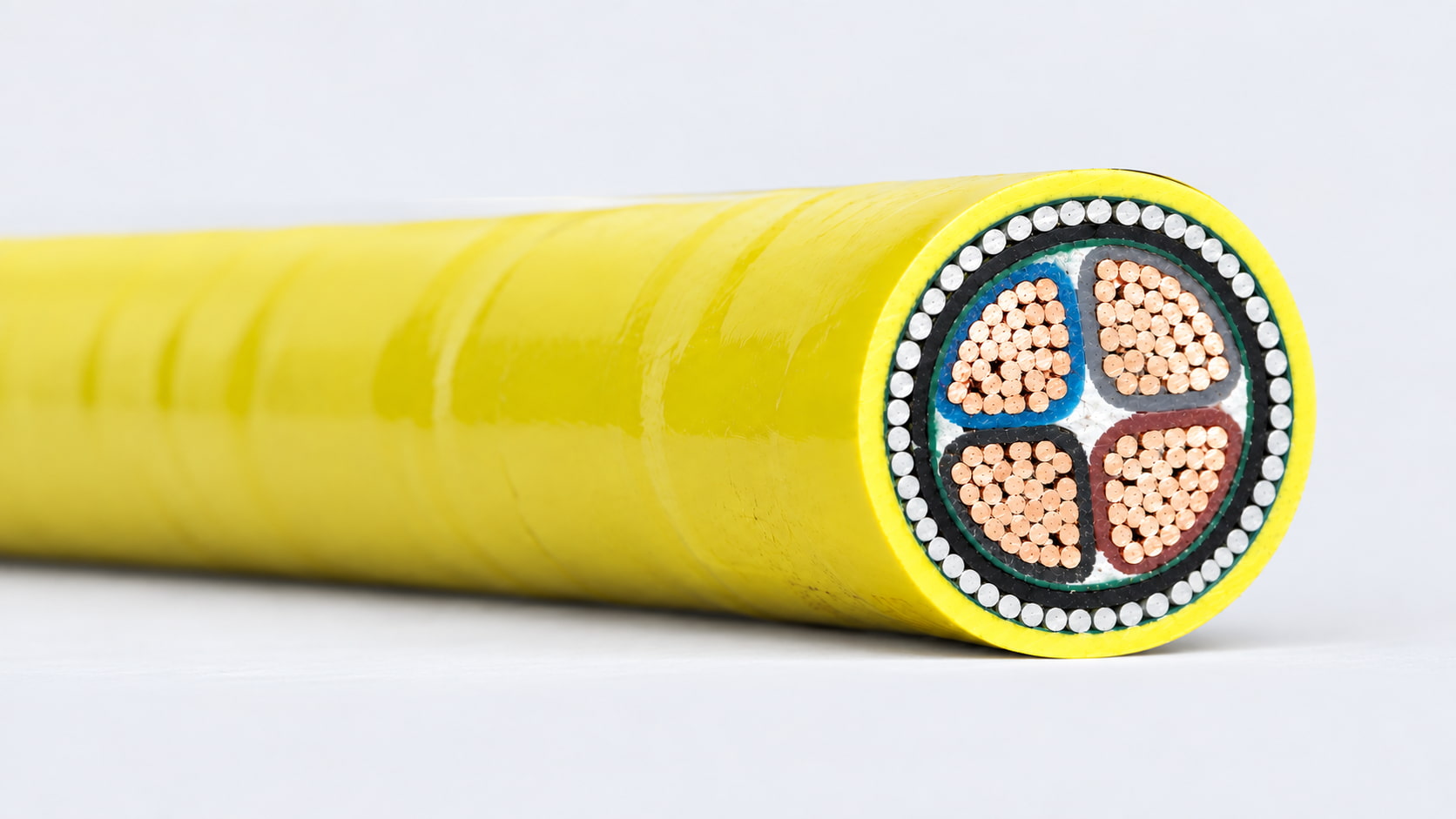
“240 mm² XLPE power cable” leaves several choices open. It does not identify the conductor material, number of cores, voltage rating, sheath or metallic layers. Expand the description even when a local cable code is familiar to your team; attach the code’s construction definition if overseas suppliers may interpret it differently.
State the size of every conductor. For example, four equal 95 mm² cores and three 95 mm² cores plus one 50 mm² core describe different constructions. Explain the function of the smaller core rather than expecting the supplier to infer it. These are notation examples, not recommendations for conductor sizing.
Where IEC conductor requirements apply, include the specified conductor class as well as material and nominal area. IEC 60228 covers conductor sizes, construction and resistance requirements; nominal area alone does not describe all of them. IEC 60228 scope.
Keep insulation and outer sheath as separate entries. Specifying XLPE insulation leaves the outer sheath requirement unresolved. For armoured cable, name the armour material and form, or ask for a defined proposal. For single-core AC cable, have the proposed metallic construction checked for the intended installation before accepting a substitution.
State the voltage and standard together
Copy the full cable voltage designation from the approved specification. A network description such as “11 kV system” provides useful context but does not, by itself, settle the cable voltage designation and construction. For medium-voltage enquiries, include the system earthing arrangement and earth-fault duration where these are needed to confirm the selection.
Avoid a generic instruction such as “IEC standard.” IEC 60502-1 addresses extruded-insulation cables in its 1 kV and 3 kV rated-voltage scope, while IEC 60502-2 addresses the 6 kV to 30 kV range within its own scope. Cite the required part and edition, with applicable amendments and corrections, and attach any additional project requirements. IEC 60502-1 scope and IEC 60502-2 scope.
If the purchase specification and another attached document disagree, resolve the conflict or state which requirement controls the quotation. Ask suppliers to identify conflicts rather than silently choose one version.
Add installation data when asking for cable selection
There is a difference between requesting a price for an approved cable and asking a supplier to propose its size or construction. For an approved design, send the approved schedule and installation restrictions. For a selection proposal, provide the inputs needed to assess the duty:
- Design load current in amperes, load pattern and any stated future allowance.
- Circuit length in metres, allowable voltage drop and fault current with clearing time.
- Installation in air, tray, duct or ground; grouping, spacing and number of loaded circuits.
- Ambient or ground temperature; burial depth and soil thermal resistivity where relevant.
- Exposure to sunlight, water, oil, chemicals or mechanical damage, plus route and bending constraints.
Current-rating calculations depend on cable construction and installation conditions. IEC 60287-1-1 explicitly addresses different installation arrangements and surrounding conditions. A catalogue current rating should therefore be accompanied by the assumptions used to obtain it. IEC 60287-1-1 scope.
Mark missing inputs clearly and request a conditional proposal. Have the responsible project engineer confirm the final selection before ordering.
Include the medium voltage interfaces
For medium-voltage cable, conductor size and voltage are only part of the enquiry. Where applicable, include the metallic screen material and area, required screen fault duty and duration, planned bonding arrangement, and water-blocking requirements. Distinguish longitudinal water blocking from protection against radial water entry.
If joints or terminations are included, attach the cable construction drawing and equipment interface details. Specify accessory types, quantities and indoor or outdoor use. Ask the supplier to confirm:
- Conductor dimensions and diameter over insulation.
- Bonded or strippable insulation screen, metallic screen construction and overall cable diameter.
- The equipment bushing interface for separable connectors.
The Euromold accessory enquiry sheet separately asks for insulation diameter, semi-conductive screen type, metallic screen type and bushing type. Cable and accessory quotations should identify who is responsible for checking compatibility.
These details can be placed in a separate medium-voltage data sheet; they do not need to clutter a straightforward low-voltage enquiry.
Turn performance labels into testable requirements
Terms such as “flame retardant,” “low smoke” and “fire resistant” describe different performance needs. Specify the test method, relevant part or category, and required result for each property your project needs.
For example, IEC 60332-1-2 assesses flame propagation on a single cable. Passing that test does not establish performance for a group of cables; the IEC 60332-3 series addresses bunched-cable testing. IEC 60332-1-2 scope and limitation.
An LSZH description also needs supporting requirements: smoke density and halogen acid gas content are assessed through different methods. Specify the applicable tests and limits rather than treating the material label as a complete performance specification. IEC 61034-2 smoke testing and IEC 60754-1 halogen acid gas testing.
If the circuit must continue operating during fire, state the appropriate circuit-integrity requirement separately, including the required duration and test conditions. Select a method whose scope matches the cable. For example, IEC 60331-1 addresses cables rated up to 0.6/1.0 kV with an overall diameter exceeding 20 mm, with specific provisions for agreed extensions. It should not be treated as a general method for all medium-voltage cables. IEC 60331-1 scope.
Apply the same discipline to “waterproof,” “UV resistant” or “oil resistant”: describe the exposure and the evidence required. Do not leave the supplier to decide what those words mean for the project.
Separate quotation evidence from shipment records
Ask for an offered cable datasheet and a compliance and deviation response against the supplied specification or schedule. For detailed project specifications, request a clause-by-clause response. Where the project requires type-test reports, third-party certification or approvals, identify the required documents and check that their scope covers the offered product and relevant manufacturer or factory.
For delivery, specify the required routine-test records, traceability, inspection documents and packing list. State any witness inspection or document approval requirements early, including when they must occur. Do not leave an inspection requirement to be introduced after the price and delivery schedule have been agreed.
A type-test report concerns the tested design and its stated scope; shipment records must be linked to the supplied cable. Ask the supplier to explain how the offered construction and delivered drums are identified in the documents. Farwalk’s Standards & Quality page outlines its approach to project-dependent checks and documentation; confirm the required package for the specific enquiry.
Specify usable lengths and the delivery basis
Total metres do not describe the required delivery. As an illustration, 2,000 m supplied on four 500 m drums is different from the same total supplied on twenty 100 m drums. State the continuous lengths needed for the planned cable pulls, whether shorter lengths are acceptable, and the permitted tolerance. Ask for a proposed drum schedule if the required lengths have not been fixed.
Include handling limits, such as maximum drum dimensions and gross weight, and request confirmation that the proposed packing meets them. Cable ends, drum labels and length records should be covered in the packing requirements. Farwalk’s export packing options provide a starting point for that discussion.
For single-core circuits, distinguish route length from total cable length and state the quantity per phase or parallel run. For a multicore cable, order cable metres rather than the combined length of its individual conductors.
Finally, make commercial comparisons on the same basis. State whether the price is per metre or per kilometre, the named delivery location and trade term, and whether accessories, tests, inspection and packing are included. Ask the supplier to state whether the price is fixed for its validity period or subject to a defined metal-price adjustment, and whether the quoted lead time means readiness for dispatch or arrival.
Require suppliers to show assumptions and deviations
Include the following instruction with the RFQ:
Please quote against the attached cable schedule and specification revision. Return an offered datasheet for each item and identify compliance, deviations and unresolved assumptions. State unit prices, total prices, proposed drum lengths, included documents, delivery basis and lead-time conditions. Quote alternatives separately and describe every change from the requested construction. Where information is missing, list the clarification needed before order confirmation.
Before comparing totals, check each offer against the same item specification, quantity, drum schedule, document package and delivery basis. Record whether each requirement is confirmed, a stated deviation or still unresolved. A cheaper offer that changes one of those conditions needs clarification before it becomes a like-for-like comparison.
Use the completed power cable RFQ checklist and template to contact Farwalk Cable about your enquiry. Include the specification revision, destination and required delivery date, and identify the inputs still awaiting engineering confirmation.
Recent Posts
October 12, 2026
AAC vs AAAC vs ACSR vs ACAR: A Buyer’s Comparison
Inquiry
Request a Cable Quote
Tell us the cable type, standard, voltage, conductor size, quantity and application. Our team will review your requirement.