
IEC 60502-1 vs IEC 60502-2: A Two-Gate Standard Routing Guide
Choosing between IEC 60502-1 and IEC 60502-2 is a standard-routing decision, not simply a choice between “low voltage” and “medium voltage.” Start with the project’s complete rated-voltage designation: IEC 60502-1 is the candidate for its stated 1 kV and 3 kV AC fixed-installation scope, while IEC 60502-2 is the candidate for 6 kV to 30 kV fixed installations.
Keep that result only after checking the application and the project documents. If either check fails, the correct output is not a forced Part 1 or Part 2 reference – it is a request for project-specific standard confirmation.
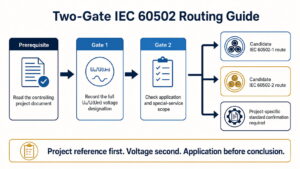
Gate 0: Check Whether the Project Already Names the Standard
Open the tender, cable schedule, utility specification, employer’s requirements or approved project document before selecting a standard from a product catalogue.
Record:
- The complete standard number
- The part number
- The edition
- Any amendment or corrigendum
- The full rated-voltage designation
- Additional project clauses
- The document that controls the inquiry
“IEC 60502 cable” is incomplete as an RFQ reference because IEC 60502 is a series containing different parts.
If a project document specifies an older edition, do not silently replace it with the latest publication found online. Record the stated edition first. Any proposed change should be raised with the party responsible for the project specification.
The applicable document hierarchy depends on the actual tender, contract, owner and utility requirements. A general website article cannot decide that hierarchy for a particular project.
Gate 1: Use the Full Voltage Designation to Identify a Candidate Part
The official IEC records divide the two cable parts by their stated voltage scopes.
| Document | Current document identity | Core stated scope | Initial routing result |
| IEC 60502-1 | IEC 60502-1:2021, Edition 3.0 | Extruded-solid-insulation power cables for rated AC voltages of 1 kV and 3 kV, primarily for fixed installations | Candidate IEC 60502-1 route |
| IEC 60502-2 | IEC 60502-2:2014+AMD1:2024 CSV, Edition 3.1 | Extruded-solid-insulation power cables from 6 kV up to 30 kV, primarily for fixed installations | Candidate IEC 60502-2 route |
The identities and scope summaries are published on the official IEC 60502-1 page and the current IEC 60502-2 consolidated-version page.
Copy the project’s complete voltage notation into the inquiry, including U₀/U(Um) where provided. Do not replace it with an informal label such as “1 kV cable,” “11 kV cable” or “MV cable” if the source document contains a more complete designation.
Candidate IEC 60502-1 Route
Use IEC 60502-1 as the initial candidate when the voltage designation falls within its stated 1 kV or 3 kV AC scope and the cable is intended for a covered fixed installation.
The route is still provisional. Installation conditions, special requirements and the requested evidence must be checked before the RFQ is completed.
After establishing the document route, the IEC 60502-1 power cable options page can serve as a product-side reference. The offered construction and supporting documents still need to be matched to the actual inquiry.
Candidate IEC 60502-2 Route
Use IEC 60502-2 as the initial candidate when the complete voltage designation falls within its stated 6 kV to 30 kV scope and the application remains within the part’s installation and service boundaries.
The corresponding IEC 60502-2 power cable options page provides the product-side handoff after the document route has been identified.
If the voltage information is incomplete or does not clearly fall within either stated range, mark the standard route as pending instead of guessing the part.
Why Voltage Alone Does Not Finish the Route
An 11 kV cable for a conventional fixed industrial installation and an 11 kV cable intended for an overhead network may share a voltage label, but they do not automatically share the same standard route.
Voltage answers the first question: Which IEC 60502 part is the initial candidate?
The application answers the second: Can that candidate be retained for the stated installation and service?
This is more precise than treating IEC 60502-1 as a synonym for every LV cable or IEC 60502-2 as a synonym for every MV cable.
When the product construction is still being defined, the wider Farwalk power cable range can be reviewed after the voltage and service information has been preserved.
Gate 2: Check the Installation and Service Conditions
Test the candidate part against the actual application. Record only the conditions that can change or invalidate the initial route:
- Whether the installation is fixed, movable, aerial, buried, ducted or underwater
- Indoor or outdoor service and any special-service environment
- AC or DC operation and the relevant voltage relationships
- Exposure to water and whether a water-barrier design is required
- Fire-performance, mechanical-protection and armour requirements that may change the construction
- Whether joints, terminations or other accessories are included
A failed application check does not prove that a suitable cable cannot be supplied. It shows that the proposed standard reference needs to be changed, supplemented or confirmed.
Special Services That Need Separate Routing
The stated scope of IEC 60502-2 does not include cables for:
- Overhead networks
- The mining industry
- Nuclear power plants in and around the containment area
- Submarine use
- Shipboard applications
These boundaries are stated on the current IEC 60502-2 official record.
A 6 kV to 30 kV voltage designation is therefore insufficient by itself for any of these services. The applicable product, service, installation or project standard must be confirmed separately.
The exclusion is a standard-scope boundary. It should not be rewritten as a claim that no suitable cable can be manufactured for the application.
Conditional DC Use Under IEC 60502-1
IEC 60502-1 includes a specific DC route for certain 1 kV rated AC cables. The cable must be designed and tested in accordance with the document and declared by the manufacturer as suitable for DC use.
Under those conditions, the official IEC scope states:
- Nominal voltage up to 750 V DC between a live conductor and neutral or earth
- Maximum voltage of 900 V DC between a live conductor and neutral or earth
- Nominal voltage up to 1,500 V DC between live conductors
- Maximum voltage of 1,800 V DC between live conductors
- Core identification according to applicable local installation regulations
These conditions are published directly on the IEC 60502-1:2021 official page.
They do not make every IEC 60502-1 cable suitable for every DC system. The buyer still needs the manufacturer’s declaration, the system voltage configuration and the applicable local identification requirements.
Water-Ingress Requirements Under IEC 60502-2
IEC 60502-2 recommends considering the possible risk of radial water ingress when determining the application. It also includes cable designs with barriers claimed to prevent longitudinal water penetration and an associated test.
Neither statement means that every IEC 60502-2 cable automatically contains a water-blocking construction.
The RFQ should state:
- Whether radial water ingress is a concern
- Whether longitudinal water blocking is required
- The requested cable construction
- The associated test or verification requirement
Without those inputs, the standard number alone does not define the required water-blocking design.
Accessories Require Their Own Standards Check
Selecting IEC 60502-2 for the cable does not complete the route for joints, terminations or other accessories.
IEC 60502-4:2023 specifies type-test requirements for accessories within its stated voltage and application scope. IEC 61442:2023 specifies test methods applicable to type testing of the covered power-cable accessories.
List accessories separately in the RFQ and provide:
- Accessory type
- Cable voltage designation
- Cable construction
- Conductor size and material
- Screen and sheath details
- Installation interface
- Required accessory standard and test evidence
A cable standard reference should not be used as a substitute for the accessory standard.
Do Not Mistake the 2026 Series Package or COR1 for a New Part Edition
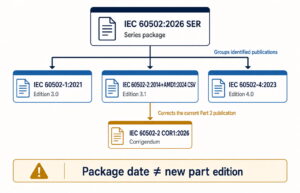
The date attached to an IEC package, amendment or corrigendum does not automatically become the publication year of every part inside the series.
| Document | Correct identity | What it means |
| IEC 60502-1 | IEC 60502-1:2021, Edition 3.0 | Part 1 base publication |
| IEC 60502-2 | IEC 60502-2:2014+AMD1:2024 CSV, Edition 3.1 | Consolidated Part 2 publication |
| COR1:2026 | Corrigendum 1 associated with the current Part 2 publication | Correction, not a new Part 2 edition |
| IEC 60502:2026 SER | A series package containing identified IEC 60502 parts | Package date, not a replacement date for each part |
| IEC 60502-4 | IEC 60502-4:2023, Edition 4.0 | Accessory test-requirement publication |
The current IEC 60502-2 page identifies the consolidated version as corrected in July 2026 and states that the content of Corrigendum 1 has been included. IEC also lists COR1:2026 separately.
The IEC 60502:2026 series package contains IEC 60502-1:2021, the IEC 60502-2 consolidated version and IEC 60502-4:2023. Its 2026 package date does not create new 2026 editions of Part 1 or Part 2.
For the RFQ, record document identity in separate fields:
| Field | Example |
| Standard part | IEC 60502-2 |
| Base publication | 2014 |
| Amendment | AMD1:2024 |
| Consolidated edition | Edition 3.1 |
| Corrigendum | COR1:2026, where relevant |
| Project-required edition | As stated in the controlling project document |
This format prevents a package date or corrigendum from being copied into the wrong field.
Use the Three-Outcome Standard Routing Card
Complete the card before retaining a standard route.
| Routing input | What to record | Decision effect |
| Controlling document | Tender, owner specification, utility requirement, cable schedule or other project document | Shows whether a standard and edition are already specified |
| Standard identity | Series, part, edition, amendment and corrigendum | Prevents an incomplete reference |
| Full voltage designation | Preserve U₀/U(Um) as provided | Identifies the initial candidate part |
| Installation | Fixed, aerial, buried, ducted, underwater or movable | Tests application scope |
| Service conditions | Mining, shipboard, nuclear containment or another special service | May require a separate route |
| AC or DC | System type and relevant voltage relationships | Tests the conditional IEC 60502-1 DC route |
| Water exposure | Radial or longitudinal water-ingress concern | Identifies information missing from the construction request |
| Accessories | Joint, termination or other accessory scope | Triggers a separate accessory-standard check |
| Required evidence | Datasheet, test report, certificate, inspection plan or other document | Defines the document handoff |
The completed card should produce one result:
- Candidate IEC 60502-1 route
- Candidate IEC 60502-2 route
- Project-specific standard confirmation required
Use this handoff block in the RFQ:
Proposed standard route: [IEC 60502-1 / IEC 60502-2 / Pending confirmation]
Required edition: [Part, edition, amendment and corrigendum]
Rated voltage: [Complete U₀/U(Um) designation]
Installation and service: [Application description]
Additional project requirements: [Construction, fire, water, armour or test requirements]
Required documents: [Datasheet, reports, certificates and inspection records]
Unresolved items: [Questions requiring project or engineering confirmation]
A Standard Reference Is Not a Product Certificate
Writing IEC 60502-1 or IEC 60502-2 in an RFQ identifies a technical reference. It does not by itself certify the cable being offered.
IEC publishes standards and operates conformity-assessment systems based on third-party certification. The relevant system, certification body, laboratory, certificate or report still has to be matched to the offered product and the project requirement. The distinction is described in the official IEC Conformity Assessment Systems Basic Rules.
Before relying on a certificate or report, check:
- Issuing body
- Legal holder
- Manufacturer and factory, where identified
- Standard and edition
- Cable construction and voltage designation
- Tested size or covered product range
- Certificate or report number
- Issue date and validity
- Whether the offered product falls within the documented scope
For site-level quality and document information, see Farwalk Standards & Quality. Product-specific evidence must still be checked against the actual inquiry.
Prepare the Standard-Route Handoff
A supplier cannot complete the route from the words “IEC power cable” alone. Include the information that changes the document, construction or evidence requirement.
Before sending the inquiry, confirm that it contains:
- Complete standard part and edition
- Complete rated-voltage designation
- Conductor material and size
- Number of cores
- Insulation, screen, armour and sheath requirements
- Installation and service environment
- Fire-performance requirements
- Water-blocking requirements
- Accessories included in the package
- Project-specific tests and inspections
- Required certificates, reports and technical documents
- Delivery destination, quantity and schedule
- Every item still awaiting project confirmation
This separates three questions that are often mixed together:
- Which standard part is the initial candidate?
- Which cable construction is required?
- Which documents must support the offered product?
Once the route and unresolved items have been recorded, send the project inputs with the inquiry so the proposed construction and document package can be checked against the same basis.
Official Sources and Scope Notes
- IEC 60502-1:2021 – Official IEC record
- IEC 60502-2 – Current consolidated IEC record
- IEC 60502:2026 – Series package
- IEC 60502-2 COR1:2026
- IEC 60502-4:2023
- IEC 61442:2023
- IEC Conformity Assessment Systems Basic Rules
This article is a procurement-oriented standard-routing guide. It does not replace the complete standards, project engineering, controlling contract documents or product-specific conformity assessment.
Recent Posts
Inquiry
Request a Cable Quote
Tell us the cable type, standard, voltage, conductor size, quantity and application. Our team will review your requirement.